

 LinkedIn
Your AEO retainer can look profitable at client one and quietly lose its margin by client ten. The usual mistake is selling a flat monthly fee while buying software billed per prompt or per seat: every successful client can make delivery more expensive as you track more products and competitors and give more people access.
The familiar response is to ration prompts or ask for an upsell. Neither is a good way to explain why you cannot track a client’s core catalogue. I watched search agencies run into versions of this trap with traditional keyword trackers. AI search has brought it back, now with more dashboards and a longer list of engines.
The rule I would build around is simple: price the retainer on defined delivery scope per domain, buy fulfillment at a flat per-domain cost with uncapped prompts, and separate monitoring from execution. That does not make labor free. It stops a growing prompt list from quietly rewriting your margins.
Step 1: What is the client actually buying?
Clients do not hire an agency for another chart showing that a competitor appeared in ChatGPT. They hire you to improve where their brand shows up. Start the statement of work by choosing what you will deliver:
- Monitoring: Track relevant prompts, competitors, and visibility changes, then alert the client or their web team to problems.
- Execution: Make the agreed website, content, structured-data, and citation changes, then document what shipped.
- Both: Monitor to find the work, execute it, and report the results. Price for both jobs.
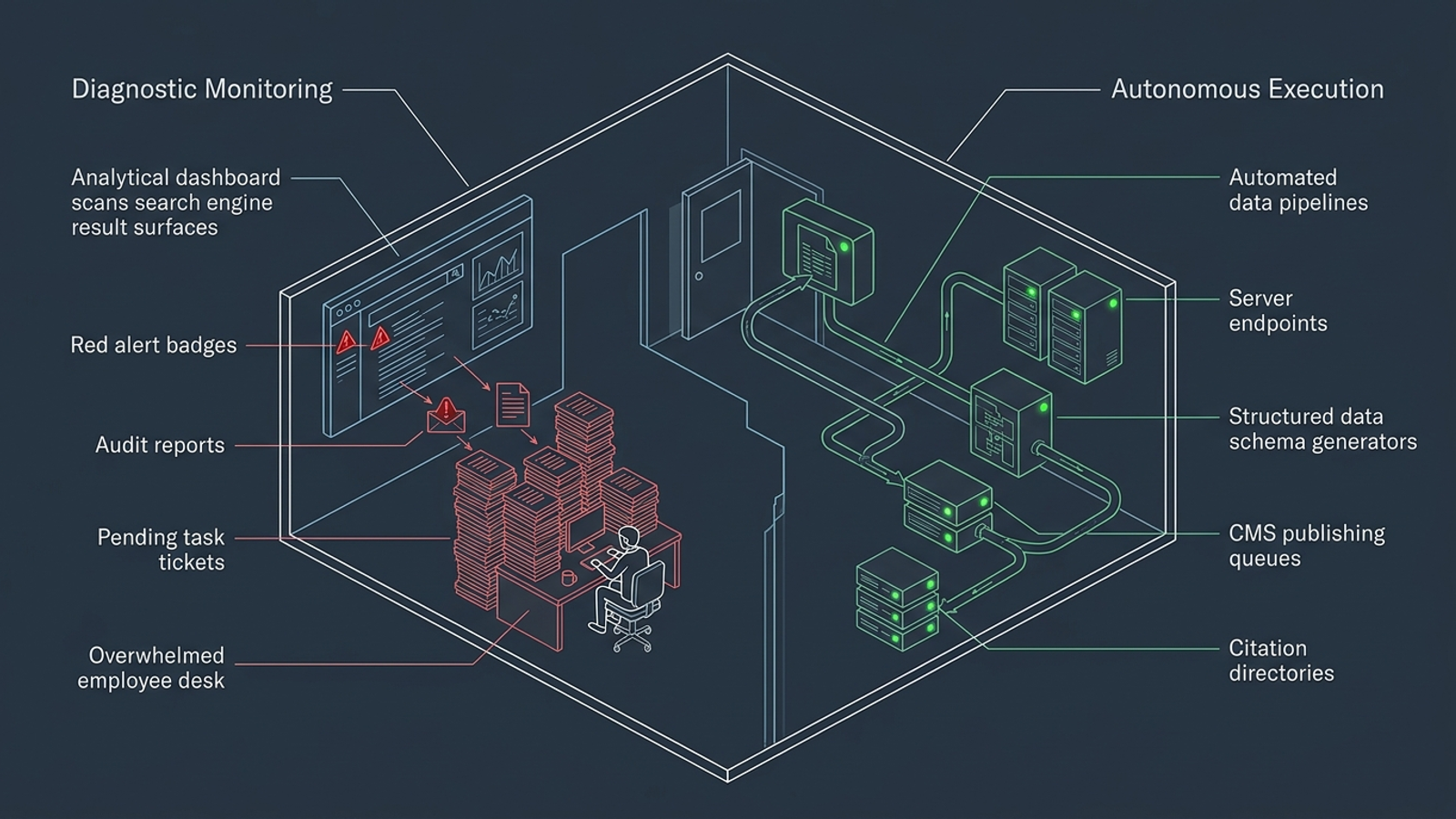
Diagnostic platforms can provide Share of Voice figures, prompt graphs, and sentiment scores without making website changes. They do not, by virtue of producing a report, deploy schema, publish a direct-answer page, or fix a crawl issue. If you sell execution and buy monitoring, your account team becomes the unpaid bridge between the dashboard and the client’s CMS.
That bridge gets expensive at ten accounts. One breakdown of 10-client AEO delivery costs puts unautomated specialist hours and tooling at $14,050 to $23,700 a month. The number to watch is not just your license fee. It is the work your license leaves behind.

Does a local client need the same scope as a national one?
No. A commercial HVAC contractor or multi-location dental practice needs work tied to its service areas: business profiles, local citations, and location-specific pages. A national B2B SaaS or ecommerce brand is more likely to need comparative pages, structured product information, third-party mentions, and clean crawling across a larger site.
Do not put every possible deliverable in every contract. Define the domain, locations, content work, and approval responsibilities before you set the fee. If a client has several locations, specify which ones the retainer covers. If their team must approve pages before publication, say who owns that step. Otherwise, a neat monthly price conceals an open-ended delivery queue. Scope is a better basis for pricing than an arbitrary count of prompts.
Step 2: How will the software bill change as clients grow?
Before you write a retainer price, read the vendor’s billing terms. Agency AEO tools generally use one of three structures:
| Pricing model | What you pay for | What can go wrong |
|---|---|---|
| Per prompt or keyword | A base allowance, then more tracking capacity | A client’s request to monitor more relevant searches increases your bill. |
| Seats and pooled credits | Access or a shared query allowance | More staff access or heavy use by one account can raise costs or consume the pool. |
| Flat per domain, uncapped prompts | Each connected client domain | Domain costs are predictable, though staff work still needs managing. |
For a concrete comparison, Semrush’s AI Visibility Toolkit is described in the draft pricing as starting at $99 a month per domain for 25 prompts, with additional prompt blocks and user access costing extra. Peec AI’s tiers illustrate the pooled-credit approach: the agency has to manage usage across accounts. groas for agencies uses the third structure at $199 a month per domain with uncapped prompts. At that rate, software costs $995 for five domains, $1,990 for ten, and $2,985 for fifteen.
Those flat-domain figures are software costs, not gross-margin projections. They do not include your strategists, client calls, approvals, or work outside the platform. What they do give you is a bill that rises with the number of domains rather than the number of questions you decide to track. That distinction matters when a useful new prompt appears: you can judge whether it belongs in the client’s scope instead of first checking whether your software allowance can bear it.
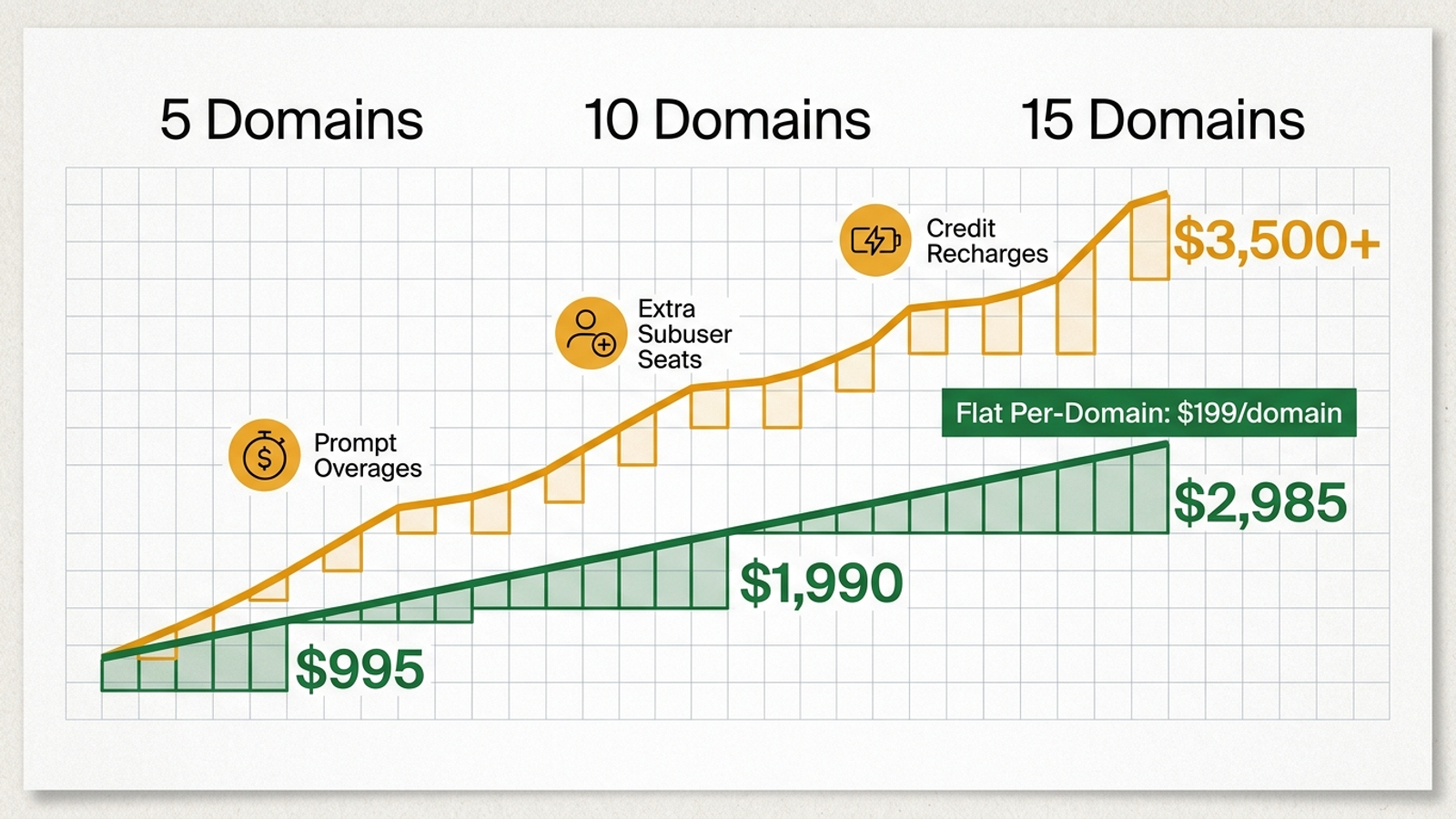
Skip the tempting package called 50 Prompts. If a client pays you to manage AI search visibility, you should not have to decide whether their next useful product variation is worth a software surcharge. Never resell capped tracking as an uncapped outcome.
Step 3: What will your team do, and what must the platform do?
Every hour a strategist spends copying content into WordPress or pasting schema into a page header is an hour they cannot spend on positioning, judgment, or the client relationship. I have done enough manual search work to respect it. I have also done enough to know that repetition does not become strategy because it appears on an invoice.
Split the jobs before you buy software:
- Give the platform repeatable execution: Crawl checks and fixes, agreed schema deployment, CMS publishing, citation distribution, and an action log.
- Keep humans on direction and accountability: Audience priorities, brand guardrails, approvals, competitor review, and client conversations.
That division only works if the platform can actually perform the first list for the client’s setup. A tool that emails missing-schema alerts has identified work; it has not fulfilled the retainer. groas for agencies combines technical audits, content generation and publishing, and AI citation monitoring with an action log. Check the execution path, not just the screenshot of the dashboard.
Step 4: What should each retainer include?
Retail pricing needs to cover the commercial work and the people accountable for it. The draft’s market references put AEO add-ons at $1,300 to $2,000 a month and foundational retainers at $2,400 to $3,200. Use those as context, not permission to announce a margin before you have costed your team’s hours.
Here is a scope ladder an agency can price and adapt:
| Retainer | Retail price | Defined delivery | Planned internal time |
|---|---|---|---|
| AI Search Add-On | $1,200–$1,500/month | AI visibility tracking, crawl hygiene, and monthly citation reporting for an existing PPC or SEO client | 1.5 hours/month for review |
| Foundational AEO & Local | $2,400–$3,200/month | CMS content publishing, schema, relevant local citations, and branded reporting | 3 hours/month |
| Multi-Location / Enterprise GEO | $4,500–$6,000/month | Regional entity work, comparative-answer targeting, and coordinated paid-search guardrails | 6 hours/month |
At $199 per domain, the first two examples each start with a $199 monthly platform cost for a single domain. The third spans $199 to $597 depending on whether it covers one, two, or three domains. Neither the platform bill nor the planned hours alone tells you gross margin. Cost your staff time, any work the platform cannot do, and your review process before you promise a percentage.
Treat the planned hours as a budget to test, not a promise that every month will fit neatly inside it. Track the time spent reviewing output, resolving approvals, and explaining changes. If those hours keep exceeding the plan, either the scope or the price needs another look. Do not call the excess ‘strategy’ and hope nobody notices it on the timesheet.
For the local tier, the local AEO retainer swipe file offers scope clauses and prompt frameworks you can adapt. The useful part is not the label on the package. It is the boundary around what your team will deliver.
Step 5: What should the client see each month?
A proprietary AI Visibility Index is not an account of your work. A client who receives only a score or a Share of Voice wheel will eventually ask a fair question: what changed on the site this month?
Make the white-label report read like a changelog. Where the information is available, show:
- Pages published: The URLs and the search intent each page addresses.
- Structured data deployed: The schema types and pages affected.
- Technical work completed: The crawl issues found and the changes made.
- Citation and prompt movement: Where the brand appeared, where it did not, and which monitored queries changed against named competitors.
Do not confuse an action with an outcome. Publishing a page is verifiable work; winning a citation is something you observe afterward, not something you guarantee. Put the two next to each other so the client can see both what the retainer delivered and what still needs attention. groas logs its actions and provides branded reporting, giving the account team a record to review rather than a blank slide deck to fill.
Step 6: Can you onboard without a developer queue?
A retainer that spends its opening weeks waiting for access has a delivery problem before the work starts. Ask how the platform connects to the client’s CMS, what permissions it needs, who approves publishing, and what happens when an automated change needs review. Do that before you promise a start date.
groas for agencies describes a quick connection and baseline audit covering crawl errors, structured data, citations, and AI visibility gaps. It also offers a seven-day live trial on one client account. Use that window to test the real workflow: connect the site, inspect what the audit finds, verify what can be executed, and check whether the action log gives your strategist enough to explain the work. A fast setup matters only if delivery follows it.
What would I refuse to sell?
Three things would stay off my pitch deck:
- Guaranteed citation positions. You can control work you publish and track where a brand appears. You cannot promise the top citation in a generated answer.
- Raw dashboard access as the deliverable. A client should not have to interpret a fluctuating prompt graph to understand what their retainer bought.
- Prompt-count tiers. 50 Prompts versus 100 Prompts makes the client negotiate against your software meter instead of the scope and value of the work.
None of these refusals means hiding results. Show the monitored queries, the changes made, and the gaps that remain. Just do not mistake a meter or a score for the service.
What should I check before signing a white-label partner?
Run this checklist against the contract and the working product, not the sales deck:
- Per-domain billing: Is the cost predictable as you add relevant prompt variants and competitors?
- Execution: Does the platform make the agreed CMS, schema, and citation changes, or merely create tickets?
- Seat costs: Will adding an account manager or strategist increase the bill?
- Action logs: Can you identify the URLs created and changes made?
- Engine coverage: Can you monitor the AI search surfaces named in your client scope?
- White-label reporting: Will the client-facing report carry your agency’s identity without vendor branding?
Today, pull three months of software invoices and divide the spend across your active client domains. Then put the hours your team spends turning tool alerts into site changes beside that figure. If you are paying more each time a client needs broader tracking while your staff still does the fulfillment by hand, stop selling that package. Redraw the scope, cost the human work, and buy delivery on terms that still make sense at client ten.