

 LinkedIn
1. Day 0: one account, $10k a month, one CPA target, no new hires
One account, $10,000 a month in ad spend, one written CPA target, 90 days, and no new hires: that is the constraint. If my fee depended on the number at day 90, I would not spend the first month calling dashboard-watching an “observation phase.” The first two weeks belong to tracking, negative keywords and leaving the bid strategy alone. Scaling can wait until the data has earned it.
At roughly $330 a day, the account has room to concentrate conversion data in one or two tightly focused campaigns. It does not have room for five campaigns, twenty ad groups and three secondary networks built to look sophisticated in a presentation. Nor does it have spare staff to clean up waste whenever someone finds time on Friday. Every choice in this plan has to earn its share of that daily budget.
Cost against the constraint: Day 0 takes setup time before the first dollar goes into the auction. What it buys: a number worth pursuing and a conversion signal the bidding system can use.
Write a CPA the business can afford
Start with customer lifetime value, subtract fulfillment and operating costs, then account for the margin the business needs to keep. That gives you an acquisition ceiling, not a target borrowed from an industry benchmark. For lead generation, apply your historical lead-to-closed-won rate to that ceiling. If a closed deal produces $2,000 in gross margin and 10% of qualified inquiries close, $200 is the maximum cost per qualified lead before any further margin requirement. Write down the actual target before launch.
Do not enter $80 on day one simply because $80 would make the forecast look lovely. A target that excludes viable auctions does not create efficiency; it can prevent the campaign from gathering enough data to learn.
Test the conversion before buying one
Submit a live test conversion through the production funnel. Verify the tag in Google Tag Assistant, then check that the Primary conversion actions in Google Ads represent attributable commercial actions. A three-second visit and a booked sales call are not equivalent, however convenient that would make the report.
If sales happen offline, connect the CRM so qualified and closed-won stages can feed back through Enhanced Conversions for Leads. The immediate job is simpler: confirm that the account records the action you intend to pay for. Bad conversion data makes every later CPA reading suspect.
2. Days 1–14: buy clean signals, not a prettier account structure
Cost against the constraint: the first two weeks consume their share of the $10,000 monthly cap without giving you permission to rebuild the account every time CPA moves. What it buys: concentrated data and a search-terms record you can act on without repeatedly changing the bidding model.
Keep the structure small enough to learn
Launch one Search campaign, or two if the product lines are genuinely distinct. Use focused, high-intent phrase and exact match keywords. Five campaigns splitting roughly $330 a day leave about $66 per campaign. In a competitive category, that can be barely enough for two clicks. Splitting the same budget does not create five opportunities to learn; it creates five thinner data sets.
The point of the learning-phase math is to give each bidding system enough conversions to make useful decisions. Aim to concentrate volume rather than treating any conversion threshold as a magic date on the calendar. I would begin with Maximize Clicks under a strict CPC limit or a conservative Target CPA, depending on the signals available at launch. Then I would keep the initial strategy in place through this opening period. Pick the controlled starting lane; do not change lanes on day four because the dashboard made you nervous.
Cut irrelevant queries while they are still cheap
The first fortnight is not passive monitoring. Inspect search terms and exclude obvious mismatches such as “free template” or “login” when they do not fit the offer. At $330 a day, a bad query can spend meaningful money before lunch. I used to do this work by hand at 1 a.m. It was necessary work, not a strategic revelation.
With no new hire in the plan, the mechanical pass needs continuous execution rather than a reminder for someone to open a tab. In an autonomous model like groas, search-term review and exclusions can run inside the account’s guardrails instead of waiting for a weekly human check-in. A named strategist still owns the direction. The point is not to automate judgment out of the account; it is to stop paying people to perform the same routine inspection late.
Leave the bid strategy and budget alone
On day four, CPA may be twice the target. That is uncomfortable, but a few days of results are not a mandate to slash bids, replace every headline and redefine a conversion in one sitting. Keep blocking clear irrelevance and fixing broken tracking. Do not change the bidding model or daily budget just to make an early graph look calmer. If you need a boundary, keep this launch-period reference beside the account.
What gets cut: device-by-device campaign duplication, secondary networks and the ceremonial week-one optimization spree. None deserves budget or attention ahead of clean conversion signals.

3. Weeks 3–4: find out what the clicks actually bought
Cost against the constraint: the account has spent roughly $7,000 by day 21 at this pace, so another broad experiment has a real price. What it buys: your first useful read on the path from query to conversion, provided tracking held up.
Suppose your written target is $140. Around 50 conversions at an average CPA near $145 would give you a much more useful baseline than a handful of early leads. Twelve conversions at $580 point to a more basic problem. Check the queries, the offer, the page and the conversion signal before announcing that Google’s bidding has failed. The numbers identify where to investigate; they do not prove the landing page is guilty on sight.
Make the page answer the ad
When relevant clicks arrive but too few people convert, the landing page is a cheaper lever than buying more traffic. Moving a conversion rate from 2.5% to 5% would halve CPA at the same click cost. That is arithmetic, not a promise that every page can make that jump. Search conversion benchmarks and landing page benchmarks are useful context; your own qualified conversions decide whether the edit worked.
Match the ad group’s strongest promise to the page’s above-the-fold headline. Remove form fields that do not help qualify or contact the prospect; if five fields are doing the work of three, keep three. Change the page, then give the result a clean read. Changing the page, bids and ad copy together leaves you with a new CPA and no idea what moved it.
What gets cut: the reflex to blame bidding for every expensive conversion, and the equally lazy reflex to blame the page without checking traffic quality. Follow the failure through the funnel before spending the next dollar to solve it.
4. Month 2: tighten one lever at a time
Cost against the constraint: month two gets another $10,000, not a larger budget or a second operator. Testing one variable means leaving other plausible ideas on the shelf. What it buys: changes you can read, rather than a pile of simultaneous edits dressed up as optimization.
By day 31, assess whether four weeks of auction data have produced a usable conversion baseline. Do not assume the account crossed 50 conversions simply because the calendar did. If volume is still thin, keep working on the traffic-to-conversion bridge instead of forcing a more aggressive target.
Move toward the written CPA without choking delivery
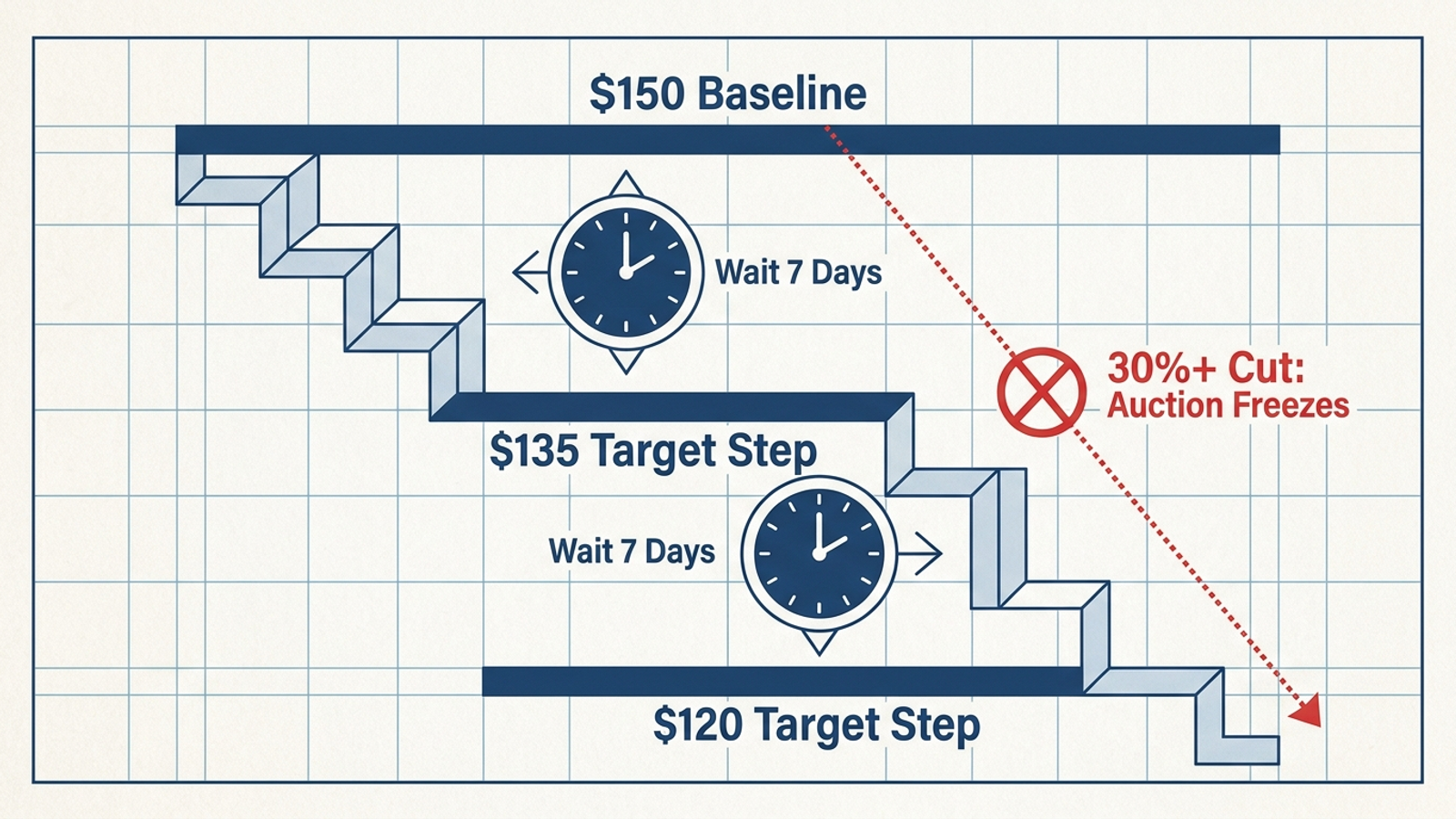
If you began on Maximize Clicks, move to Target CPA only when the conversion data supports the change. If you already run Target CPA and performance is stable at $150 against a $120 written goal, do not slash the setting straight to $120. Tighten in 10%–15% steps, then allow seven to ten days to read each move. Google’s target-adjustment guidance is a useful check against the temptation to make a dramatic cut. A first move from $150 to $135 asks for more efficiency without pretending the auction changed overnight.
That is a bidding adjustment, not an increase in the monthly cap. The written business target stays fixed; the setting moves toward it as the account earns room to do so. If delivery collapses, the dashboard has given you information. Do not call an empty auction a CPA win.
Test one copy variable
Keep the proven value proposition in Headline 1. In Headline 2, test an assertive risk-reversal hook against a standard feature claim, then let the test gather enough conversions before picking a winner. Replacing all fifteen responsive search ad headlines at once may feel productive. It mostly destroys your ability to explain the result.
What gets cut: the wholesale creative overhaul and the week when bids, copy and page layout all change together. Month two is for controlled decisions, not for giving every good idea its own confounding variable.
5. Month 3: earn more volume inside the same $10k cap
Cost against the constraint: the monthly spend ceiling remains $10,000 and headcount remains unchanged. More volume has to come from less waste and stronger conversion, not from quietly doubling the daily budget. What it buys: a test of whether the account can produce more qualified acquisitions at the written CPA under the terms you actually agreed to.
By day 60, you have either a working acquisition pattern or a diagnostic trail. If CPA is within 10% of the Day 0 target and qualified volume supports that reading, keep the winning search themes funded within the cap. Remove spend from weak or irrelevant traffic before giving stronger themes more room. If CPA is still far above target, do not rename a budget increase “scaling.” Return to the query, page, offer and downstream sales data.
This is where the no-new-hire rule matters. Manual search-term mining, budget pacing and routine bid work expand as an account grows. Automation can absorb that operating load, while a strategist remains accountable for the commercial guardrails. With groas for businesses, specialized models handle continuous execution and a named strategist owns direction. That is a better use of this constraint than adding payroll or paying a percentage-of-spend fee for mechanical account work.
What gets cut: extra networks, speculative search themes and the proposed jump from roughly $330 to $660 a day. That jump breaks the $10,000-a-month plan. It belongs after the constraint lifts, if the results warrant it.
6. Every Friday: audit the signals before reading the score
A $10,000 monthly account without extra staff does not need a twenty-page status deck. It needs a short, repeatable check that the conversion signal still means what it meant on Day 0, the monthly cap is intact and the sales team recognizes the leads. Keep this checklist in order; the final item is the one most likely to turn an attractive platform CPA into a bad business decision.
- Primary conversion actions: Confirm that pageviews and other secondary actions have not been made Primary; otherwise they contaminate bidding signals.
- Budget pacing: Compare the last seven days of spend with the roughly $330 daily pace and check the remaining monthly runway.
- Search-term hygiene: Review the negative-keyword log and investigate irrelevant queries that spent money before exclusion.
- Lost impression share: Separate budget pressure from rank problems before asking for spend the plan does not have.
- Ad assets: Review weak headlines after they have enough impressions to judge; do not replace working copy out of boredom.
- Downstream CRM attribution: Match platform conversions to qualified pipeline and closed-won results every week; skip this and a falling CPA can hide leads that never become customers.
7. Day 90: decide what the number earned
Cost against the constraint: the sprint used three months of capped spend and no additional payroll. What it buys: a verdict against the CPA written on Day 0, backed by a record of what the account bought and what happened afterward.
If qualified acquisitions meet the target, you have a channel worth expanding. If they do not, the work is not rescued by calling the launch a learning experience. Find the specific break: irrelevant traffic, a weak page or offer, a target disconnected from the available auctions, thin commercial search volume, or platform conversions that did not turn into qualified pipeline. Fix that break before buying more of it.
When the constraint lifts, keep the same margin guardrails. Then test adjacent high-intent search themes and dedicated landing pages. If the CPA and downstream revenue still hold, increase daily budget in 15%–20% steps every four to five days, rather than jumping from $330 to $660 overnight. Feed verified closed-won revenue back into the operating loop. More budget is the next move only after the original $10,000 a month has proved what it can buy.