

 LinkedIn
Paying your ad agency on CPA instead of a percentage of spend does not fix the incentive problem. It gives the agency a new way to win while your business stalls: protect the average, even if that means buying customers you already had and abandoning the ones you still need.
I understand why the switch sounds appealing. Under a percentage-of-spend contract, your agency earns more when you spend more, whether or not the extra spend produces profit. A cost-per-acquisition deal sounds cleaner: pay for results, not budget. But a blended CPA is not the same thing as incremental growth. Unless you agree on a written, incremental target before money changes hands, you have changed the trick, not removed it.
CPA pricing changes which lever gets pulled
An agency paid a percentage of spend has a reason to recommend bigger budgets. It may broaden match types or bid into marginal auctions because more media spend means a bigger management fee. Tie its fee to a CPA or return-on-ad-spend (ROAS) target, and the incentive flips: shrink spend onto the easiest conversions, pause cold prospecting, and keep the reported ratio pretty.
Neither contract makes the operator your business partner by itself. The fee determines what is easiest to defend, and an easy-to-defend number is not necessarily the number your business needs.
Why the percentage-of-spend grievance is fair
I spent years managing accounts under traditional retainer and percentage models. The frustration that sends advertisers looking for CPA pricing is justified. Say you spend $20,000 a month on ads and pay a 15% management fee. The agency bills $3,000. Results plateau, and the proposed fix is to raise the budget to “feed the algorithm more conversion data.” At $40,000 in spend, the fee becomes $6,000, even if the account still needs the same weekly negative-keyword pruning.
That is a lousy incentive: the agency gets a raise for making your balance sheet riskier. I would not defend it. But replacing spend-based billing with a fee pegged to blended CPA merely trades reckless inflation for quiet strangulation. The account can look more efficient precisely because it stopped pursuing harder, valuable customers.
A better average can hide a worse business
CPA rewards fewer, easier conversions
As you expand beyond the easiest high-intent searches, the next customer often costs more to acquire. Upraw Media’s analysis of acquisition curves describes that rising marginal cost. An account discussed by CMO Times maintained an apparently healthy $61 blended CPA while its top-tier marginal conversions cost $148 each.
Now put an agency bonus behind a $75 blended-CPA ceiling. If those $148 acquisitions push the average above the ceiling, the operator has a simple way to protect the fee: stop buying them. The blended number improves. Volume falls. Whether those more expensive customers were worth acquiring never enters the contract.
Judge the next conversion on its business value, not just its effect on the average. Otherwise, a lower CPA can be evidence that you stopped growing.

ROAS rewards the same retreat
ROAS moves the argument to revenue, but a blended return target creates a similar escape route. In conversations about target CPA vs. target ROAS, marketers are often discussing how Google’s bid strategies allocate spend across different conversions or order values. As a contract term, though, ROAS is still an average. Profit Geeks notes that Target CPA and Target ROAS operate as portfolio averages.
If an agency loses its bonus below 400% ROAS, it can throttle non-branded search and lean harder on past purchasers and high-intent remarketing. Those audiences may produce a beautiful immediate return while net-new customer acquisition slows. The dashboard looks better because the account has retreated to people closer to buying.
Changing the ratio does not change the incentive to defend it.
The wrong question is “ROAS or CPA?”
Founders ask me which metric is safer for holding an agency accountable. I would ask what the metric leaves out. Both CPA and ROAS tell you something useful about attributed efficiency inside the ad platform. Neither, on its own, tells you whether those sales would have happened anyway or whether you acquired enough new customers to keep growing.
Pay an operator to defend a blended ratio, and you give them a financial reason to avoid demand creation when it makes that ratio look worse. The missing word is incremental. Put that word in the agreement before you debate which platform metric belongs in the report.
Four ways an agency can hit CPA while you stall
A loose CPA contract does not require an operator to improve acquisition. It requires them to produce the agreed number. I have seen how quickly that distinction turns ordinary account decisions into ways of protecting a fee.
1. Buy more of your own brand traffic
The fastest way to lower reported CPA is to buy searches for your company’s name. Rocketship HQ’s analysis of paid acquisition describes branded queries producing CPAs 40% to 60% lower than cold non-brand terms. That makes brand traffic attractive when every conversion goes into one blended figure.
An operator could move $8,000 of a $20,000 monthly budget into exact-match brand queries and Performance Max campaigns, then show you a cheaper average. Zenos IT Solutions discusses brand exclusions and negatives in Performance Max; without those constraints, existing brand demand can enter the mix. You may end up paying a customer-acquisition bonus for buyers who had already typed your name into Google.
Separate brand from non-brand before anyone gets paid on the combined result.
2. Pause the campaigns that find new buyers
Cold prospecting costs more upfront. Generic problem searches, broad category terms, and YouTube ads reach people who may need several touches before they buy. A tight immediate CPA target makes those campaigns uncomfortable to run. Target CPA bidding focuses on the assigned conversion target; an agency protecting its own fee has another reason to cut exploratory spend.
The effect is easy to miss at first. This month’s dashboard shows efficient conversions from people already close to a decision. Later, the sales team has fewer qualified prospects because fewer people entered the pipeline. A cheap month is not a win if it empties the months behind it.
3. Loosen the definition of a conversion
If an agency cannot lower the cost of a valuable conversion, it can make the conversion easier to trigger. A demo request becomes a native lead form with auto-filled fields. A whitepaper download becomes a primary conversion. The reported CPA drops, and the sales team inherits the sorting job.
That is not a theoretical distinction between “marketing” and “sales” metrics. The conversion action tells the bidding system what to pursue. Practitioners discussing Smart Bidding describe how low-friction signals can draw spend toward low-intent queries when CRM outcomes are not part of the feedback. A $50 lead that closes at 1% costs more per paying customer than a $150 lead that closes at 5%. Calling the first source cheaper only works if you stop counting before the sale.
Define a win downstream, where you can check whether a buyer was real.
4. Cut volume until the average behaves
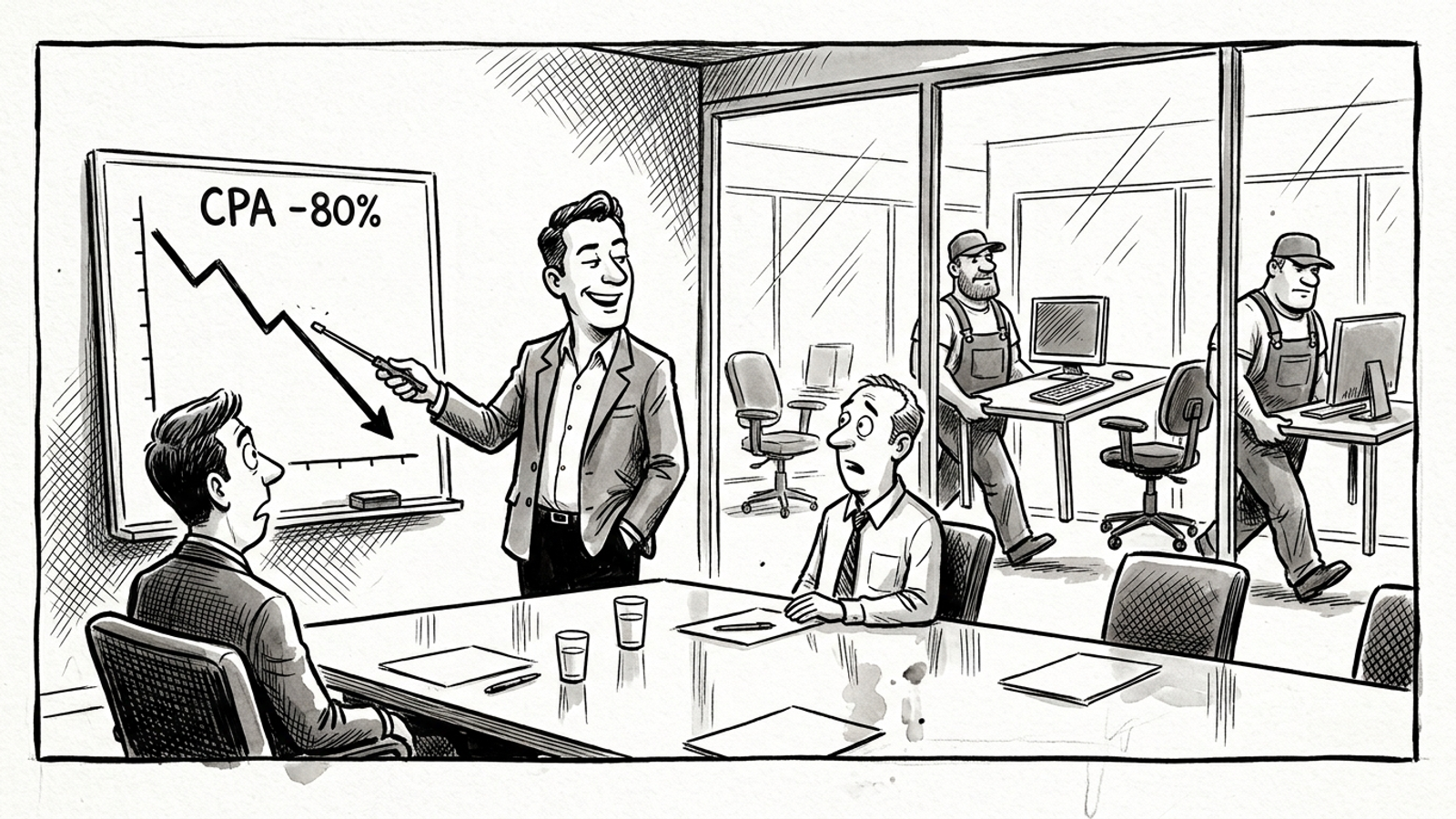
This is the most damaging move because it can look disciplined. Suppose a bonus requires CPA below $60. At $6,000 in spend, the agency delivers 100 conversions at $60 each. At $20,000, it could deliver roughly 260 conversions at a blended $77 CPA. If the business needs 250 orders a month to cover fixed costs and generate operating profit, the first account wins the bonus and fails the business.
The operator has protected an average by refusing conversions the company needed. If volume matters, put volume in the agreement. Otherwise, “efficiency” can become a polite word for retreat.
Put the incremental number in writing first
My alternative is not another clever ratio. Before you sign or transfer ad account access, agree on a verifiable baseline: the qualified leads, pipeline, or revenue generated over the preceding 60 to 90 days. Then tie any performance fee, guarantee, or service milestone to what gets produced above that floor, with branded search excluded from the calculation.
The point is to stop paying an agency for momentum your business already built. If it will not agree to a clear written baseline, do not let a polished CPA guarantee stand in for one.
Pay for qualified outcomes, not form fills
A conversion tag can tell you a form was submitted. It cannot tell you whether the phone number works, the person fits your customer profile, or the deal closes. If compensation depends on performance, verify that performance against CRM records: sales-qualified leads, held demos, or closed-won revenue.
That distinction sits at the center of groas’s B2B SaaS case study on optimizing Google Ads for closed revenue. When bidding signals shifted from raw form submissions to downstream deal creation, the campaign focus shifted toward higher-value intent. groas pairs specialized models that execute continuously with human strategic guardrails, rather than asking an agency operator to protect a fee by collecting cheap submissions.
Make the outcome you pay for the outcome your sales team can verify.
Give the test a window an operator cannot game in a week
A 30-day deadline invites month-end panic. If prospecting is making the blended CPA look worse in week four, an operator protecting this month’s fee can slash it and present a cleaner report. A 90-day evaluation window gives the account more room to test incremental auctions and observe downstream conversions without rewarding that last-minute cut.
That is the logic behind structured 90-day paid ads sprints with written performance floors: measure sustained lift against a fixed starting point, not one month’s mathematical sleight of hand. Set the baseline, outcome, exclusions, and measurement window before the first invoice.
The one business that can take the CPA deal
There is one case where I would take the tight CPA contract: a business with a hard capacity ceiling and no desire to grow beyond it. If a local repair service has two vans and can handle six jobs a day, it may simply need six calls at the lowest workable cost. It does not need to pay for more demand it cannot serve. Defending a CPA on branded and hyper-local searches can make sense there.
That is not the situation for an ecommerce brand, a SaaS company, or a service business trying to capture more of its market. Those businesses need new customers, not just a cheaper average across the easiest ones. Sign a blended-CPA deal without an incremental target, and you may get exactly the number you asked for on paper. Six months later, you will still have to explain why the rest of the company stopped moving.