

 LinkedIn
I have taken over accounts where the manager optimized to ROAS, the client expected leads at £120, and finance put break-even at £85. Nobody had written down which number the account answered to, so every report could tell a different story. The CPA-vs-ROAS argument is mostly the wrong argument. The real failure is moving money before anyone agrees on a metric, a value, a source of truth and a date. This is the pre-flight sheet I wish those accounts had: 12 checks to complete before a sprint, agency or new hire starts work. Do them in order, and keep the answers where the person approving spend can find them.
Get the three inputs before choosing a metric
-
Write down gross margin after cost of goods sold, not just revenue. Break-even starts here: break-even ROAS is 1 divided by gross margin. At 40% margin, you need 2.5x ROAS just to cover the product cost and ad spend. On a £200 order, that leaves £80 of gross margin to pay for the click. A 3x ROAS leaves something, but it may still lose money once fulfilment and fees clear. The common mistake is to pick a revenue multiple that looks healthy on a dashboard without asking what remains in the bank account. Put the margin calculation beside the proposed target; otherwise, the target has no floor. If nobody can explain which costs sit inside that margin, do not let the number acquire authority just because it has a decimal point.
-
Write down average order value, or average contract value times close rate if you sell leads. This converts a sale into a defensible limit on what you can pay to acquire one. A £3,000 contract at 50% margin and a 20% close rate gives you a £300 break-even cost per lead. That is a ceiling, not a sensible profit goal. If close rate differs by service line, do the calculation for each line rather than borrowing the best one for every form fill. I have seen teams price leads as though every enquiry becomes a customer. Write down the rate you actually intend to use before you argue about the bid strategy. Keep the contract value and close rate beside the resulting ceiling so the arithmetic remains visible at review time.
-
Pull the last 90 days of tracked conversions by action name. Record monthly volume and whether revenue values pass with those conversions. This is a feasibility check, not a prize for choosing the more advanced setting: under roughly 30 conversions a month, I would not rush to set Target CPA; without trustworthy values on most orders, I would not set Target ROAS. Those are working checks, not a claim that Google cannot run a strategy below a particular count. Keep the action names in front of you. If the report mixes purchases, qualified calls and raw form fills, its total cannot tell you which outcome a target would buy. Mark the action you want the account judged on before moving to item 4. A total conversion count without its component actions is not enough to make this choice.
Pick the metric that matches what you can measure
-
If you sell leads without reliable revenue values, pick CPA on the lead action that matters. Target CPA predicts whether a conversion will happen; it does not need an invented deal value attached to each enquiry. That makes it the cleaner starting point for lead generation, local leads and subscriptions with stable first-order value. Do not mistake that for permission to count every form fill as a sale. Use the strongest conversion action you can track consistently, then compare its cost with the ceiling from item 2. Forcing ROAS onto guessed values gives Smart Bidding a number to optimize, but not necessarily one the business can collect.
-
If you sell products with trustworthy order values, pick ROAS. CPA gives a €20 order and a €400 order the same weight, which is a poor fit for a basket where order values vary. ROAS lets the value of a conversion affect the bidding decision. I would still inspect whether a small number of unusually large orders make the recent value data jump around; for high-average-order-value Search, I may start with CPA instead of letting one £4,000 order dominate a week of £400 orders. That is a judgment about the data, not a rule that expensive products should never use ROAS. Choose the metric the tracked orders can support today.
-
For services with different close rates or long sales cycles, use CPA on qualified leads, not raw fills. A blended lead count can make the cheapest service line look like the best source of customers when it closes less often. Maximum lead CPA equals maximum customer cost times lead-to-customer rate: at a £600 customer-cost ceiling, a 20% close rate gives a £120 lead ceiling; an 8% close rate gives £48. Name the qualification point and calculate against its own close rate. This is the check teams skip before celebrating cheap leads that never close. A mixed product basket calls for the value check in item 5; mixed service leads call for this one.
Check what the bidding system will count
-
Choose one primary conversion source for each outcome; leave micro-actions secondary. Smart Bidding spends toward the conversions you designate as primary. Scrolls, video views and similar micro-actions belong in secondary reporting if the business target is a purchase or qualified lead. Check the exact action name, not just the conversion total at the top of the account. A tidy-looking CPA on a collection of easy actions is not the CPA you agreed to buy. Write the chosen primary action on the target sheet so nobody can quietly change what a conversion means halfway through the review window. If the action changes, date the change and revisit the baseline before comparing results.
-
Check for double-counting before trusting the baseline. A native purchase tag and a GA4 import can both record the same order. If both count as primary, the account can report more conversions than the business made, making either CPA or ROAS look better than it is. Choose one primary source for that event and move the duplicate out of bidding before setting the target. Do the same check for lead events that arrive through more than one route. This is not a request for a prettier report; inflated conversion counts change what the system is rewarded for. Do not calculate a break-even target against a total you already know is duplicated.
-
Confirm that order values pass and offline outcomes join back to the click. Target ROAS needs values on the conversions it uses. For B2B, check that offline uploads contain the click identifier and timestamp needed for the chosen upload process; inconsistent uploads can fail to map outcomes back to their clicks. Missing joins do not merely leave a blank in a report. They can make the account look better or worse depending on which deals disappear. If values or qualified outcomes are not arriving consistently, fix that path before asking a bid strategy to hit a tighter number. Record the gap on the sheet rather than treating an incomplete baseline as a fact.
Build a baseline that will survive a review meeting
-
Pull 90 days of actual CPA or ROAS, note seasonality, then set the opening target near recent performance. The 90-day view shows what the account has been doing; the recent weeks help you choose a starting bid target. Google advises basing Target ROAS on actual results after values have had time to report. Keep break-even separate from that opening target: at 40% margin, 2.5x is the floor before other costs, not proof that the account can suddenly deliver a profitable number above it. I use this break-even ROAS framework before anyone types a goal into Google Ads. A target far above history can starve delivery rather than persuade the system to try harder. If finance cannot supply margin yet, label the break-even figure provisional, name its owner and date the correction. Do not silently substitute the historical average for the business goal; write down both and make the gap visible.
-
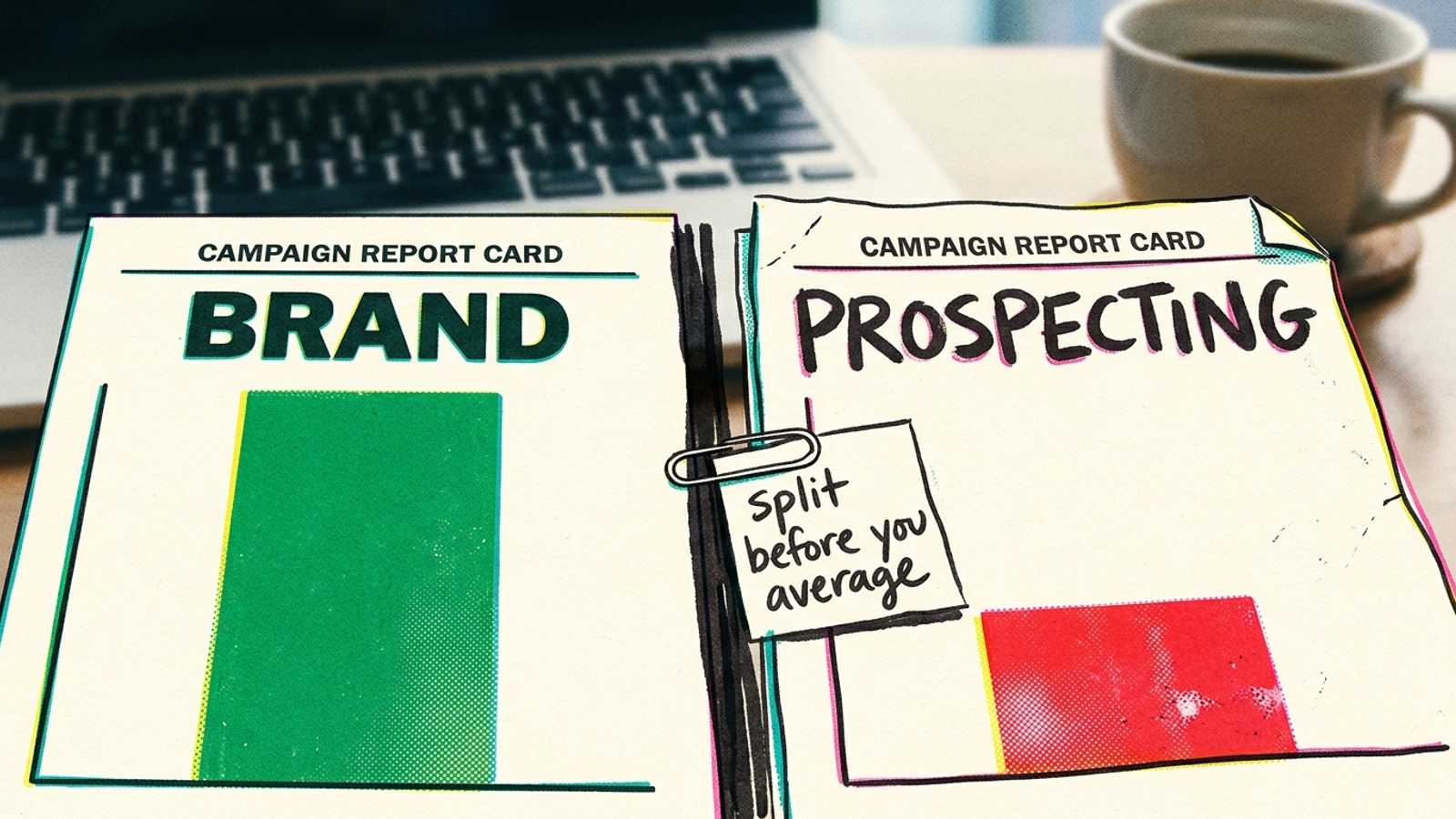
Split branded from non-branded before averaging anything. Brand demand can be far cheaper to acquire, while a strong brand Search ROAS can hide weak prospecting ROAS. The draft report may say 4.1x overall while non-branded prospecting sits at 1.8x against a 2.5x break-even. That is not one account beating one target; it is two kinds of demand being averaged into a comforting sentence. Give each scope its own baseline and break-even check. If you also judge PMax or the account total, name that scope explicitly. No one should be able to meet a prospecting promise by adding more branded conversions to the report.
Put the target where nobody can quietly rewrite it
Use one sheet per scope. Fill the fields before kickoff, keep the saved version with the invoices, and date any later change. The bidding strategy carries the chosen number; it does not invent the business case for it. I would put this sheet in front of a sprint team, an agency or an in-house hire. Leave a field blank only if you also name who will fill it and when; an empty owner or review date is an invitation to renegotiate after the spend is gone:
Metric: [CPA / ROAS] on [exact conversion action]
Value: [£___ CPA / ___x ROAS] | Break-even: [£___ / ___x]
Scope: [branded / non-branded / PMax / total]
Baseline: [last 90 days value + dates + seasonality note]
Volume check: [conversions per month + values passing Y/N]
Window: [trailing 30 days, judged on date ___]
Owner + source of truth: [name + Ads / GA4 / CRM]
If missed: [specific action, not “optimize harder”]
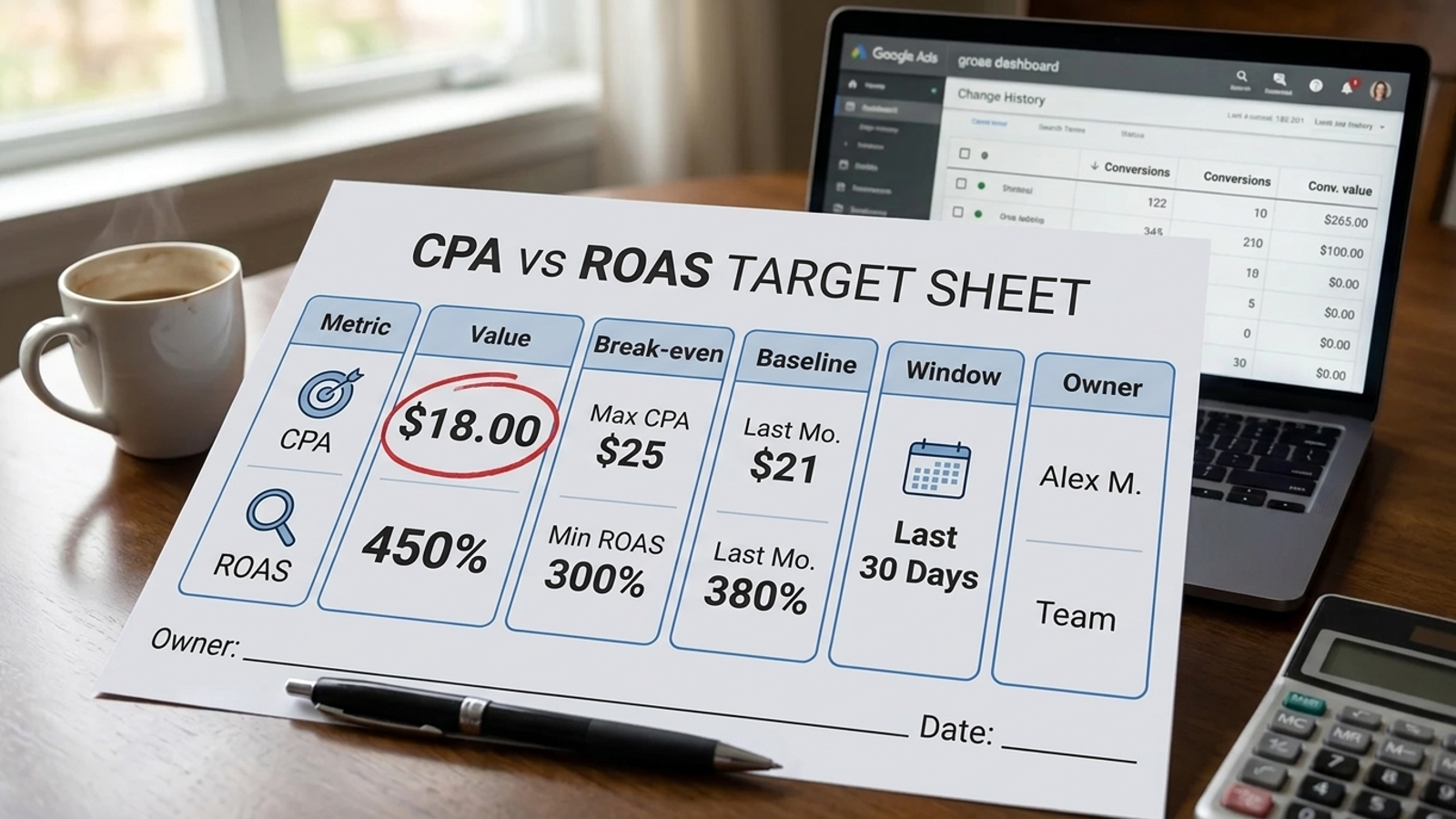
- Write one sentence both sides sign: metric, value, window, source of truth, owner, review date and action if missed. Name the conversion action from item 7 and the scope from item 11. For example: Non-branded Search answers to £120 CPA on qualified calls, measured on Google Ads primary conversions over the trailing 30 days, owner [name], review on [date]. If missed by more than 15% for two conversion cycles, we cut test budget 20% and revisit close rate before touching the target. Once it is live, date each change and allow the result time to read; small adjustments and a two-to-four-week review window are more useful than rewriting the promise after every bad week. If the account has only 18 conversions in 30 days and no values passing, do not set a tighter target to force efficiency. I used to think that would work. I was wrong. Fix the measurement and volume problem first; Maximize Conversions without a target is the sequence to consider while the account builds a readable baseline. Make sure the signed sentence uses the same conversion action and scope as the sheet. If the team will not sign it, find out before spend moves.
Item 12 is the one most often skipped, and it costs the whole agreement. Without a signed number, a £72 CPA on raw fills can be called a win while qualified CPA sits at £210. Two months later, the report may be accurate and the spend may be real, but nobody can say the account missed its target: nobody wrote one down.